Monday, 31 March 2025

Season finale

Neat B and I were in Park City this past weekend for our last runs of the season. (Now it's time to pull out the impossibly tight spandex for road biking!) This is a trip we do often, but given the current geopolitical situation, we weren't exactly sure what to expect. But I will say that we were pleasantly surprised.  ‌ ‌ ‌ ‌ ‌ ‌ ‌ ‌ ‌ ‌ ‌ ‌ ‌ ‌ ‌ ‌ ‌ ‌ ‌ ‌ ‌ ‌ ‌ ‌ ‌  ‌ ‌ ‌ ‌ ‌ ‌ ‌ ‌ ‌ ‌ ‌ ‌ ‌ ‌ ‌ ‌ ‌ ‌ ‌ ‌ ‌ ‌ ‌ ‌ ‌  ‌ ‌ ‌ ‌ ‌ ‌ ‌ ‌ ‌ ‌ ‌ ‌ ‌ ‌ ‌ ‌ ‌ ‌ ‌ ‌ ‌ ‌ ‌ ‌ ‌  ‌ ‌ ‌ ‌ ‌ ‌ ‌ ‌ ‌ ‌ ‌ ‌ ‌ ‌ ‌ ‌ ‌ ‌ ‌ ‌ ‌ ‌ ‌ ‌ ‌  ‌ ‌ ‌ ‌ ‌ ‌ ‌ ‌ ‌ ‌ ‌ ‌ ‌ ‌ ‌ ‌ ‌ ‌ ‌ ‌ ‌ ‌ ‌ ‌ ‌  ‌ ‌ ‌ ‌ ‌ ‌ ‌ ‌ ‌ ‌ ‌ ‌ ‌ ‌ ‌ ‌ ‌ ‌ ‌ ‌ ‌ ‌ ‌ ‌ ‌ 

Season finale

Brandon Donnelly

Neat B and I were in Park City this past weekend for our last runs of the season. (Now it's time to pull out the impossibly tight spandex for road biking!) This is a trip we do often, but given the current geopolitical situation, we weren't exactly sure what to expect. But I will say that we were pleasantly surprised. When we picked up our rental car at SLC, the attendant, who was from Texas, immediately said that he was trying to figure out how to become the next Canadian province. He then proceeded to inquire about the quality of our brisket in a way that made it sound like a firm prerequisite. And virtually everyone we met on the mountain was extremely apologetic once they learned we were Canadians from Toronto. Frankly, they came across embarrassed, and they made it clear that they do not approve of what their government is doing right now. This made us happy to hear.

I still love you, Park City.

Cover photo by Alex Moliski on Unsplash


Sent via Paragraph

Web3 writing & publishing

2010 El Camino Real Office 2350

Santa Clara, CA 95050

You're receiving this because you subscribed to this newsletter.

Unsubscribe or Manage Preferences

Sunday, 30 March 2025

Some thoughts on work-life balance

Sahil Bloom tweeted this out a few days ago: "The single greatest challenge for any ambitious person is eliminating the guilt associated with free time and rest." And it really resonated with me. I'm sure it does with a lot of you as well. I'm guilty of feeling this guilt.  ‌ ‌ ‌ ‌ ‌ ‌ ‌ ‌ ‌ ‌ ‌ ‌ ‌ ‌ ‌ ‌ ‌ ‌ ‌ ‌ ‌ ‌ ‌ ‌ ‌  ‌ ‌ ‌ ‌ ‌ ‌ ‌ ‌ ‌ ‌ ‌ ‌ ‌ ‌ ‌ ‌ ‌ ‌ ‌ ‌ ‌ ‌ ‌ ‌ ‌  ‌ ‌ ‌ ‌ ‌ ‌ ‌ ‌ ‌ ‌ ‌ ‌ ‌ ‌ ‌ ‌ ‌ ‌ ‌ ‌ ‌ ‌ ‌ ‌ ‌  ‌ ‌ ‌ ‌ ‌ ‌ ‌ ‌ ‌ ‌ ‌ ‌ ‌ ‌ ‌ ‌ ‌ ‌ ‌ ‌ ‌ ‌ ‌ ‌ ‌  ‌ ‌ ‌ ‌ ‌ ‌ ‌ ‌ ‌ ‌ ‌ ‌ ‌ ‌ ‌ ‌ ‌ ‌ ‌ ‌ ‌ ‌ ‌ ‌ ‌  ‌ ‌ ‌ ‌ ‌ ‌ ‌ ‌ ‌ ‌ ‌ ‌ ‌ ‌ ‌ ‌ ‌ ‌ ‌ ‌ ‌ ‌ ‌ ‌ ‌ 

Some thoughts on work-life balance

Brandon Donnelly

Sahil Bloom tweeted this out a few days ago:

And it really resonated with me. I'm sure it does with a lot of you as well. I'm guilty of feeling this guilt. Because by definition, if you have a strong desire to do or to achieve something, then you're going to want to spend a lot time working toward it. And any time not spent working toward it, can feel like an unnecessary slowdown or delay.

But it's easy to let time melt away when you're in this headspace and I'm trying to be better at not letting this happen. For one thing, there are diminishing returns to work. We all need free time and rest. It makes us better at everything else we do in life.

It's also really easy to fill our lives with unnecessary bullshit. The same thing happens in our homes when we're not paying attention: we end up collecting unnecessary stuff. So as Paul Graham argues in this 2016 essay called "Life Is Short", it's important to "relentlessly prune bullshit." Focus on the things that matter, and don't wait.

When you're ambitious, I think it's easy to become focused on the future. I've been told I do this too much. Achieving something usually requires hard work and determination, and that likely means it won't happen today; it'll happen at some point in the future. So it can be easy to discount the present. But nobody knows how much healthy future we all have.

These are all things that I'm trying to be better at and so I'm writing them down here as a reminder. How do you manage your work-life balance?

Cover photo by Christopher Gower on Unsplash


Sent via Paragraph

Web3 writing & publishing

2010 El Camino Real Office 2350

Santa Clara, CA 95050

You're receiving this because you subscribed to this newsletter.

Unsubscribe or Manage Preferences

Saturday, 29 March 2025

Sundance Film Festival is moving from Park City to Boulder

This past Thursday, the Sundance Institute announced that it will be moving the Sundance Film Festival from Park City to Boulder starting in 2027. This is sad. Sundance has been based in Park City since 1981 and it's the largest independent film festival in the US. Last year (2024), it is estimated that it created 1,730 jobs for residents, contributed $132 million in GDP to Utah, and produced about $13.8 million in state and local tax revenue. Here's what Park City Mayor Nann Worel had to say...  ‌ ‌ ‌ ‌ ‌ ‌ ‌ ‌ ‌ ‌ ‌ ‌ ‌ ‌ ‌ ‌ ‌ ‌ ‌ ‌ ‌ ‌ ‌ ‌ ‌  ‌ ‌ ‌ ‌ ‌ ‌ ‌ ‌ ‌ ‌ ‌ ‌ ‌ ‌ ‌ ‌ ‌ ‌ ‌ ‌ ‌ ‌ ‌ ‌ ‌  ‌ ‌ ‌ ‌ ‌ ‌ ‌ ‌ ‌ ‌ ‌ ‌ ‌ ‌ ‌ ‌ ‌ ‌ ‌ ‌ ‌ ‌ ‌ ‌ ‌  ‌ ‌ ‌ ‌ ‌ ‌ ‌ ‌ ‌ ‌ ‌ ‌ ‌ ‌ ‌ ‌ ‌ ‌ ‌ ‌ ‌ ‌ ‌ ‌ ‌  ‌ ‌ ‌ ‌ ‌ ‌ ‌ ‌ ‌ ‌ ‌ ‌ ‌ ‌ ‌ ‌ ‌ ‌ ‌ ‌ ‌ ‌ ‌ ‌ ‌  ‌ ‌ ‌ ‌ ‌ ‌ ‌ ‌ ‌ ‌ ‌ ‌ ‌ ‌ ‌ ‌ ‌ ‌ ‌ ‌ ‌ ‌ ‌ ‌ ‌ 

Sundance Film Festival is moving from Park City to Boulder

Brandon Donnelly

This past Thursday, the Sundance Institute announced that it will be moving the Sundance Film Festival from Park City to Boulder starting in 2027. This is sad. Sundance has been based in Park City since 1981 and it's the largest independent film festival in the US. Last year (2024), it is estimated that it created 1,730 jobs for residents, contributed $132 million in GDP to Utah, and produced about $13.8 million in state and local tax revenue.

Here's what Park City Mayor Nann Worel had to say following the announcement:

"For over 40 years Park City wasn't just the host of the festival, we were its home. We helped shape the identity of Sundance with our unique energy, our colorful people, our undeniable spirit," Worel said. "The world came here for film, yes, but they stayed for something more. They stayed for the feeling this town gave them. So, yes, I'm disappointed. Deeply. I know many of you are, too."

"To our community: We are not defined by one event. Our creative spirit is deeper than any single festival. And while Sundance may be leaving, Park City isn't going anywhere," Worel said.

As I understand it, Utah offered to nearly double the amount of funding that they provide to the arts festival. But that clearly wasn't enough. There's also speculation that the festival left because it had overgrown Park City and/or because Colorado is viewed as being more liberal. There are people in Utah who do not approve of some of the content shown at said festival. I have no idea as to the actual reasons. But I do think it's a real loss for Utah.

Cover photo by Spencer Davis on Unsplash


Sent via Paragraph

Web3 writing & publishing

2010 El Camino Real Office 2350

Santa Clara, CA 95050

You're receiving this because you subscribed to this newsletter.

Unsubscribe or Manage Preferences

Friday, 28 March 2025

New York's congestion pricing is doing what it's supposed to do

New York City was supposed to terminate its congestion pricing program last Friday because, well, Trump told them to. But they didn't do it and so harsh words were exchanged and then the deadline was extended for another 30 days. (This sounds oddly familiar.) Who knows what happens next month, but we are able to accurately quantify the benefits of nearly 3 months of congestion pricing. Firstly, it's generating a lot of money. In the first two months of operation, congestion pricing has alread...  ‌ ‌ ‌ ‌ ‌ ‌ ‌ ‌ ‌ ‌ ‌ ‌ ‌ ‌ ‌ ‌ ‌ ‌ ‌ ‌ ‌ ‌ ‌ ‌ ‌  ‌ ‌ ‌ ‌ ‌ ‌ ‌ ‌ ‌ ‌ ‌ ‌ ‌ ‌ ‌ ‌ ‌ ‌ ‌ ‌ ‌ ‌ ‌ ‌ ‌  ‌ ‌ ‌ ‌ ‌ ‌ ‌ ‌ ‌ ‌ ‌ ‌ ‌ ‌ ‌ ‌ ‌ ‌ ‌ ‌ ‌ ‌ ‌ ‌ ‌  ‌ ‌ ‌ ‌ ‌ ‌ ‌ ‌ ‌ ‌ ‌ ‌ ‌ ‌ ‌ ‌ ‌ ‌ ‌ ‌ ‌ ‌ ‌ ‌ ‌  ‌ ‌ ‌ ‌ ‌ ‌ ‌ ‌ ‌ ‌ ‌ ‌ ‌ ‌ ‌ ‌ ‌ ‌ ‌ ‌ ‌ ‌ ‌ ‌ ‌  ‌ ‌ ‌ ‌ ‌ ‌ ‌ ‌ ‌ ‌ ‌ ‌ ‌ ‌ ‌ ‌ ‌ ‌ ‌ ‌ ‌ ‌ ‌ ‌ ‌ 

New York's congestion pricing is doing what it's supposed to do

Brandon Donnelly

New York City was supposed to terminate its congestion pricing program last Friday because, well, Trump told them to. But they didn't do it and so harsh words were exchanged and then the deadline was extended for another 30 days. (This sounds oddly familiar.) Who knows what happens next month, but we are able to accurately quantify the benefits of nearly 3 months of congestion pricing.

Firstly, it's generating a lot of money. In the first two months of operation, congestion pricing has already brought in over $100 million in new revenue for the city. This is important because it's money that can be used for transit and other infrastructure improvements.

Equally important is the fact that this money was generated by creating measurable value for drivers. For all of the river crossings that lead into the CBD, average weekday travel times this past January are lower compared to January 2024. And in some cases, they're lower by a lot. The Holland Tunnel, for example, saw travel times drop by 48%.

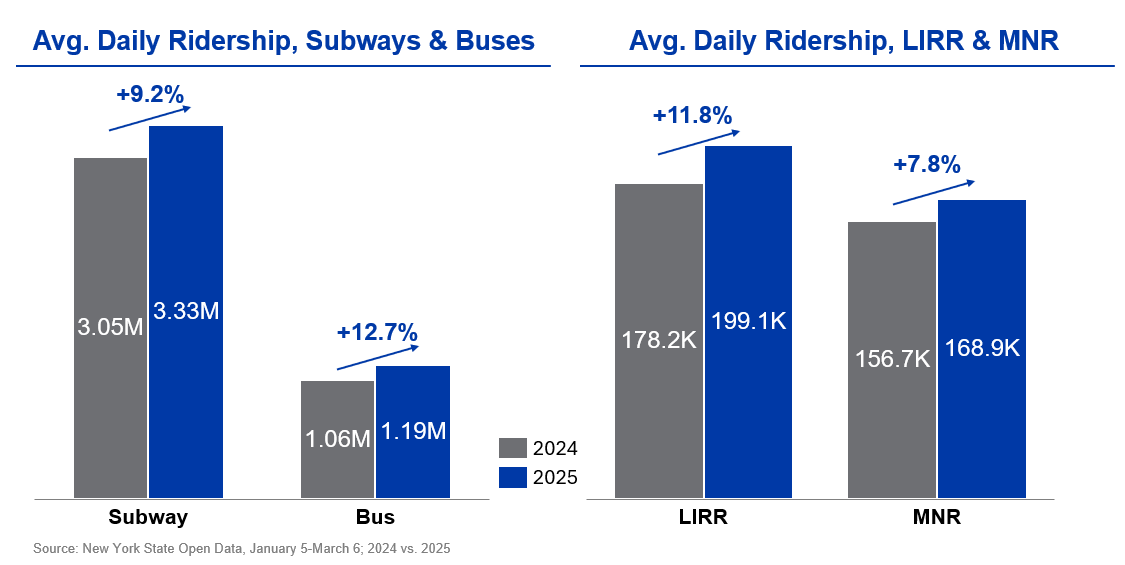
Lastly, it's encouraging more people to take public transit. Here's a chart from Sam Deutsch over at Better Cities showing the increases in ridership since the program was implemented:

The MTA as a whole is now averaging about 448,000 more public transit riders per day. And to put this number into perspective, Sam reminds us that Washington DC has the second most-used public transit system in the US and that it sees an average of about 304,000 total riders per day (January 2024 figure). So in other words, New York's congestion pricing bump alone was nearly 1.5x DC's entire ridership base.

Some critics will argue that NYC's subway is dangerous and that this program unfairly pushes people toward it. But crime data suggests otherwise. New York's subway also saw over a billion rides in 2024! So I don't know how you argue that less people should be taking it. It's pretty clear that this is what moves the city. Imagine if the above went the opposite way and 448,000 more people started driving to work.

Some people may not like it, but the reality is that congestion pricing is doing exactly what it's intended to do: reduce traffic congestion, make money, and encourage more sustainable forms of urban mobility.

Cover photo by Wells Baum on Unsplash


Sent via Paragraph

Web3 writing & publishing

2010 El Camino Real Office 2350

Santa Clara, CA 95050

You're receiving this because you subscribed to this newsletter.

Unsubscribe or Manage Preferences

Thursday, 27 March 2025

Risky backyards

Among other things, insurance companies now use aerial photography, combined with AI, to better assess property-level risk. Here's an excerpt from Bloomberg Green:"Weather and catastrophe losses are running ahead of the ability to manage them, and many insurers are having trouble sustaining their business because they're not getting the right rates," said Jay Guin, chief research officer of the extreme event solutions team at Verisk, a catastrophe modeling firm. "AI changes the equation." Zur...  ‌ ‌ ‌ ‌ ‌ ‌ ‌ ‌ ‌ ‌ ‌ ‌ ‌ ‌ ‌ ‌ ‌ ‌ ‌ ‌ ‌ ‌ ‌ ‌ ‌  ‌ ‌ ‌ ‌ ‌ ‌ ‌ ‌ ‌ ‌ ‌ ‌ ‌ ‌ ‌ ‌ ‌ ‌ ‌ ‌ ‌ ‌ ‌ ‌ ‌  ‌ ‌ ‌ ‌ ‌ ‌ ‌ ‌ ‌ ‌ ‌ ‌ ‌ ‌ ‌ ‌ ‌ ‌ ‌ ‌ ‌ ‌ ‌ ‌ ‌  ‌ ‌ ‌ ‌ ‌ ‌ ‌ ‌ ‌ ‌ ‌ ‌ ‌ ‌ ‌ ‌ ‌ ‌ ‌ ‌ ‌ ‌ ‌ ‌ ‌  ‌ ‌ ‌ ‌ ‌ ‌ ‌ ‌ ‌ ‌ ‌ ‌ ‌ ‌ ‌ ‌ ‌ ‌ ‌ ‌ ‌ ‌ ‌ ‌ ‌  ‌ ‌ ‌ ‌ ‌ ‌ ‌ ‌ ‌ ‌ ‌ ‌ ‌ ‌ ‌ ‌ ‌ ‌ ‌ ‌ ‌ ‌ ‌ ‌ ‌ 

Risky backyards

Brandon Donnelly

Among other things, insurance companies now use aerial photography, combined with AI, to better assess property-level risk. Here's an excerpt from Bloomberg Green:

"Weather and catastrophe losses are running ahead of the ability to manage them, and many insurers are having trouble sustaining their business because they're not getting the right rates," said Jay Guin, chief research officer of the extreme event solutions team at Verisk, a catastrophe modeling firm. "AI changes the equation."

Zurich Insurance Group AG, one of the largest insurers in Europe, uses AI powered risk-modeling software to assess catastrophe risk and often tweaks it for its own purpose.

"If there's fire hazard like vegetation, overhang or debris in your backyard that shouldn't be there, we can tell you to lower the risk otherwise we may not be able to underwrite you," said Ericson Chan, chief information and digital officer of the Swiss company.

What AI allows is a level of granularity that just wasn't possible when humans were the ones who had to do it. Insurers now talk about "continuous remote risk monitoring," meaning they can use AI-powered aerial imagery to constantly check on that risky debris in your backyard.

This feels like quite an improvement for the insurance industry. But when you more accurately price risk, I would imagine that it will lead to more insurers deciding to stay clear of certain risks and certain properties, as has already been the case in places like California.

Cover photo by Pim de Boer on Unsplash


Sent via Paragraph

Web3 writing & publishing

2010 El Camino Real Office 2350

Santa Clara, CA 95050

You're receiving this because you subscribed to this newsletter.

Unsubscribe or Manage Preferences

Monday, 24 March 2025

Canada's housing shortage is nuanced

This is an important chart taken from this recent article by Steve Lafleur talking about the need for Canada to "bulk up." What it obviously shows is that housing completions and population growth have generally been diverging in Canada since the 1970s. Back then, we were building about 200,000 homes a year and, today, we're building slightly under that. Of course, our population has also grown dramatically during this time period, as has the number of people who move to Canada each year. The...  ‌ ‌ ‌ ‌ ‌ ‌ ‌ ‌ ‌ ‌ ‌ ‌ ‌ ‌ ‌ ‌ ‌ ‌ ‌ ‌ ‌ ‌ ‌ ‌ ‌  ‌ ‌ ‌ ‌ ‌ ‌ ‌ ‌ ‌ ‌ ‌ ‌ ‌ ‌ ‌ ‌ ‌ ‌ ‌ ‌ ‌ ‌ ‌ ‌ ‌  ‌ ‌ ‌ ‌ ‌ ‌ ‌ ‌ ‌ ‌ ‌ ‌ ‌ ‌ ‌ ‌ ‌ ‌ ‌ ‌ ‌ ‌ ‌ ‌ ‌  ‌ ‌ ‌ ‌ ‌ ‌ ‌ ‌ ‌ ‌ ‌ ‌ ‌ ‌ ‌ ‌ ‌ ‌ ‌ ‌ ‌ ‌ ‌ ‌ ‌  ‌ ‌ ‌ ‌ ‌ ‌ ‌ ‌ ‌ ‌ ‌ ‌ ‌ ‌ ‌ ‌ ‌ ‌ ‌ ‌ ‌ ‌ ‌ ‌ ‌  ‌ ‌ ‌ ‌ ‌ ‌ ‌ ‌ ‌ ‌ ‌ ‌ ‌ ‌ ‌ ‌ ‌ ‌ ‌ ‌ ‌ ‌ ‌ ‌ ‌ 

Canada's housing shortage is nuanced

Brandon Donnelly

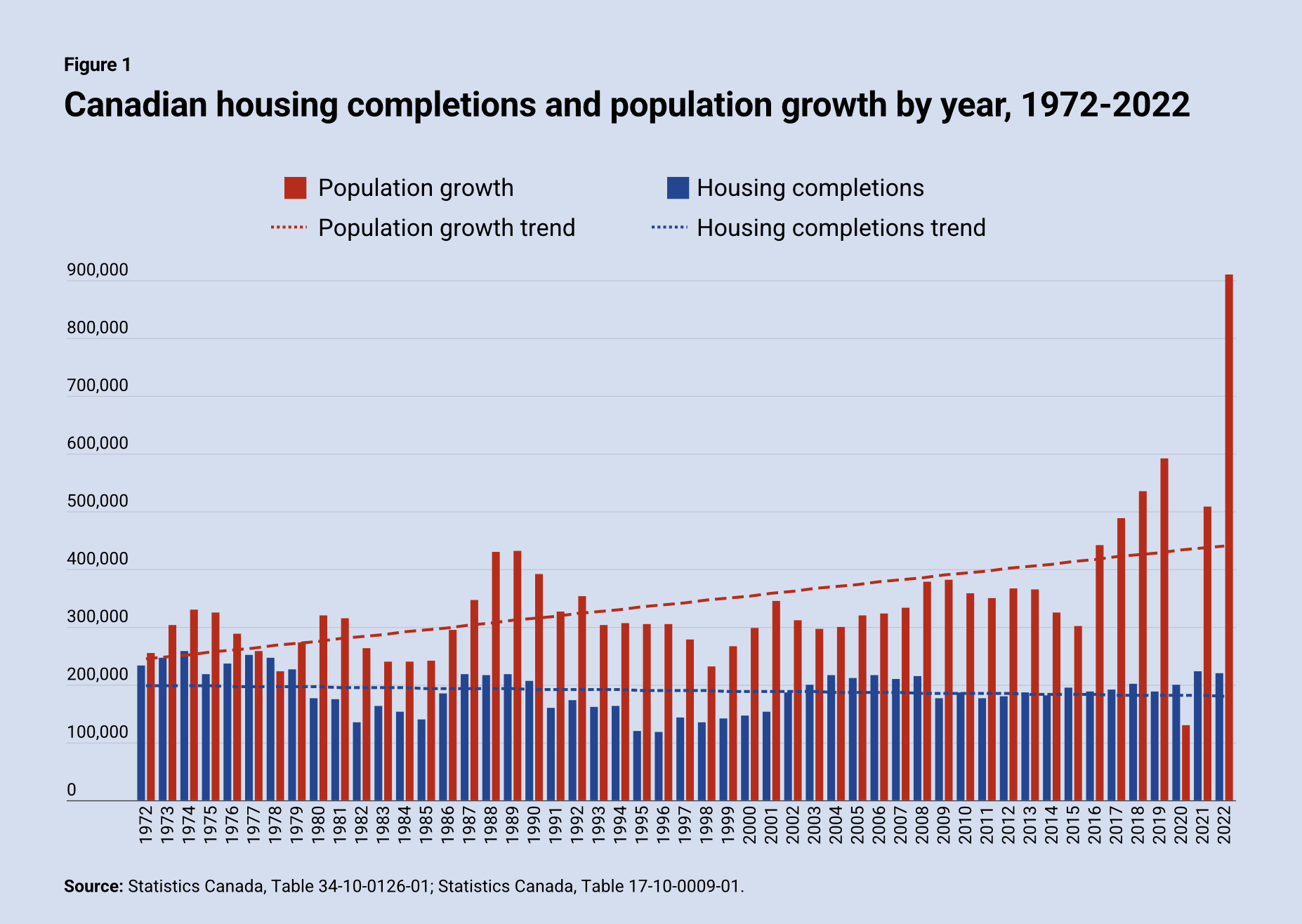
This is an important chart taken from this recent article by Steve Lafleur talking about the need for Canada to "bulk up." What it obviously shows is that housing completions and population growth have generally been diverging in Canada since the 1970s.

Back then, we were building about 200,000 homes a year and, today, we're building slightly under that. Of course, our population has also grown dramatically during this time period, as has the number of people who move to Canada each year. The result is that the Canada Mortgage Housing Corporation estimates that we'll have a housing shortage of approximately 3.5 million homes by 2030.

But we already knew this. Big numbers are often thrown around in studies. I think the more important question is: How do we reconcile this massive shortage with the fact that, in cities like Toronto, we have lots of zoned land ready for the construction of new housing (but that isn't financially feasible) and lots of unsold homes that aren't selling right now?

Do we really have a shortage?

Well, Toronto is just one specific market, and I can't speak to all the dynamics playing out across the country and the world. But it strikes me that what's missing from the above chart, and this discussion in general, are considerations around (1) housing type and (2) affordability. And by type, I'm largely thinking about size, as it's closely linked to affordability.

If what we're building is too expensive for most people and unsuitable for their household needs, then yes, I guess that would mean we have a shortage of housing.

Cover photo by Matt Wang on Unsplash


Sent via Paragraph

Web3 writing & publishing

2010 El Camino Real Office 2350

Santa Clara, CA 95050

You're receiving this because you subscribed to this newsletter.

Unsubscribe or Manage Preferences

Sunday, 23 March 2025

100 million Canadians by 2100 is not actually that ambitious

My recent post titled "Canada must become a global superpower" has quickly become one of my most-read posts in the almost 12 years that I have been writing this daily blog. Within a few days, it quickly got to 11x the number of daily views that I typically get. One of the points that I made was about Canada's population, and specifically the target set by the Century Initiative of 100 million Canadians by 2100. Today I'd like to expand on this point, because I'm seeing more people talk about ...  ‌ ‌ ‌ ‌ ‌ ‌ ‌ ‌ ‌ ‌ ‌ ‌ ‌ ‌ ‌ ‌ ‌ ‌ ‌ ‌ ‌ ‌ ‌ ‌ ‌  ‌ ‌ ‌ ‌ ‌ ‌ ‌ ‌ ‌ ‌ ‌ ‌ ‌ ‌ ‌ ‌ ‌ ‌ ‌ ‌ ‌ ‌ ‌ ‌ ‌  ‌ ‌ ‌ ‌ ‌ ‌ ‌ ‌ ‌ ‌ ‌ ‌ ‌ ‌ ‌ ‌ ‌ ‌ ‌ ‌ ‌ ‌ ‌ ‌ ‌  ‌ ‌ ‌ ‌ ‌ ‌ ‌ ‌ ‌ ‌ ‌ ‌ ‌ ‌ ‌ ‌ ‌ ‌ ‌ ‌ ‌ ‌ ‌ ‌ ‌  ‌ ‌ ‌ ‌ ‌ ‌ ‌ ‌ ‌ ‌ ‌ ‌ ‌ ‌ ‌ ‌ ‌ ‌ ‌ ‌ ‌ ‌ ‌ ‌ ‌  ‌ ‌ ‌ ‌ ‌ ‌ ‌ ‌ ‌ ‌ ‌ ‌ ‌ ‌ ‌ ‌ ‌ ‌ ‌ ‌ ‌ ‌ ‌ ‌ ‌ 

100 million Canadians by 2100 is not actually that ambitious

Brandon Donnelly

My recent post titled "Canada must become a global superpower" has quickly become one of my most-read posts in the almost 12 years that I have been writing this daily blog. Within a few days, it quickly got to 11x the number of daily views that I typically get.

One of the points that I made was about Canada's population, and specifically the target set by the Century Initiative of 100 million Canadians by 2100. Today I'd like to expand on this point, because I'm seeing more people talk about it on the socials.

At the time of writing this post, Canada's official population clock from Statistics Canada was sitting at 41,591,151 people. So to reach 100 million in the next 75 years, it would mean we would need to grow our population by 58,408,861 people. At first glance, this seems like a big number. And to some, it has proven to be an unsettling proposition. But 75 years is a long time for compounding to work its magic.

For us to reach 100 million Canadians by 2100 it would mean that we would need to grow our population by a compounded annual growth rate of just 1.18% per year. On our current population base, that would mean about 490,000 new people next year. To put this into perspective, since Confederation in 1867, Canada's population growth rate has averaged around 1.2% per year.

So by arguing that we want to reach 100 million Canadians by 2100, we are, in a way, just saying "we should continue what we've been doing since 1867 and not change a whole lot." The status quo should inevitably lead us to 100 million people during this time period.

Of course, history isn't exactly the same. Canada's fertility rate was much higher in previous years. At the beginning of the 20th century it was nearly five children per woman. And in 1960, it was 3.81 births per woman, which placed us ahead of the US.

Today, we are 1.26 births per woman (2023), compared to 1.66 in the US (2022). We are now among the countries classified as having "lowest-low fertility." Meaning, we're sub 1.3. What this means is that we are now more dependent on immigration to maintain the same growth rate as before.

At the same time, it's not like we're unaccustomed to high immigration. Between 1901 and 1921, Canada's population increased by almost 3% a year on average. This was in large part because of immigrants from Europe, specifically the British Isles. And between 1901 and 1911, alone, Canada welcomed 1.2 million people. This is at a time when we had just over 5 million people in the entire country.

So in the end, 100 million Canadians by 2100 is probably not all that ambitious. A compound annual growth rate of 1.5% would, for example, have us grow to over 127 million people. That would be more of a stretch. There's also the important question of how quickly are we growing relative to other countries.

Whatever the exact target, I stand by what I said before. We should be aiming to lower the cost of living for Canadians, and in particular housing costs. We should make it easier for families to have more babies, should they choose to. And we should continue to attract the smartest and most ambitious people from around the world.

Cover photo by Kevin LEE on Unsplash


Sent via Paragraph

Web3 writing & publishing

2010 El Camino Real Office 2350

Santa Clara, CA 95050

You're receiving this because you subscribed to this newsletter.

Unsubscribe or Manage Preferences

Saturday, 22 March 2025

Toronto has the best laneway sushi

I love Toronto. It's my favorite city. And every so often, there will be a moment that explicitly reminds me why I love it so much. That happened yesterday when I walked down a laneway off College Street to find a somewhat hidden sushi spot called Oroshi Fish Co. Right away I was delighted by the combination of the small street and the mix of uses housed on it. But then, I walked inside to find two guys manhandling the carcass of an enormous bluefin tuna, and that's when I really said to myse...  ‌ ‌ ‌ ‌ ‌ ‌ ‌ ‌ ‌ ‌ ‌ ‌ ‌ ‌ ‌ ‌ ‌ ‌ ‌ ‌ ‌ ‌ ‌ ‌ ‌  ‌ ‌ ‌ ‌ ‌ ‌ ‌ ‌ ‌ ‌ ‌ ‌ ‌ ‌ ‌ ‌ ‌ ‌ ‌ ‌ ‌ ‌ ‌ ‌ ‌  ‌ ‌ ‌ ‌ ‌ ‌ ‌ ‌ ‌ ‌ ‌ ‌ ‌ ‌ ‌ ‌ ‌ ‌ ‌ ‌ ‌ ‌ ‌ ‌ ‌  ‌ ‌ ‌ ‌ ‌ ‌ ‌ ‌ ‌ ‌ ‌ ‌ ‌ ‌ ‌ ‌ ‌ ‌ ‌ ‌ ‌ ‌ ‌ ‌ ‌  ‌ ‌ ‌ ‌ ‌ ‌ ‌ ‌ ‌ ‌ ‌ ‌ ‌ ‌ ‌ ‌ ‌ ‌ ‌ ‌ ‌ ‌ ‌ ‌ ‌  ‌ ‌ ‌ ‌ ‌ ‌ ‌ ‌ ‌ ‌ ‌ ‌ ‌ ‌ ‌ ‌ ‌ ‌ ‌ ‌ ‌ ‌ ‌ ‌ ‌ 

Toronto has the best laneway sushi

Brandon Donnelly

I love Toronto. It's my favorite city. And every so often, there will be a moment that explicitly reminds me why I love it so much. That happened yesterday when I walked down a laneway off College Street to find a somewhat hidden sushi spot called Oroshi Fish Co. Right away I was delighted by the combination of the small street and the mix of uses housed on it. But then, I walked inside to find two guys manhandling the carcass of an enormous bluefin tuna, and that's when I really said to myself, "man, Toronto is awesome." The sushi is some of the best you'll find in the city.

Here are a few photos.


Sent via Paragraph

Web3 writing & publishing

2010 El Camino Real Office 2350

Santa Clara, CA 95050

You're receiving this because you subscribed to this newsletter.

Unsubscribe or Manage Preferences

The case for elevated rail

There is a school of thought that elevated rail is bad, or at least suboptimal, for cities. The thinking is that it's a visual blight, i...