
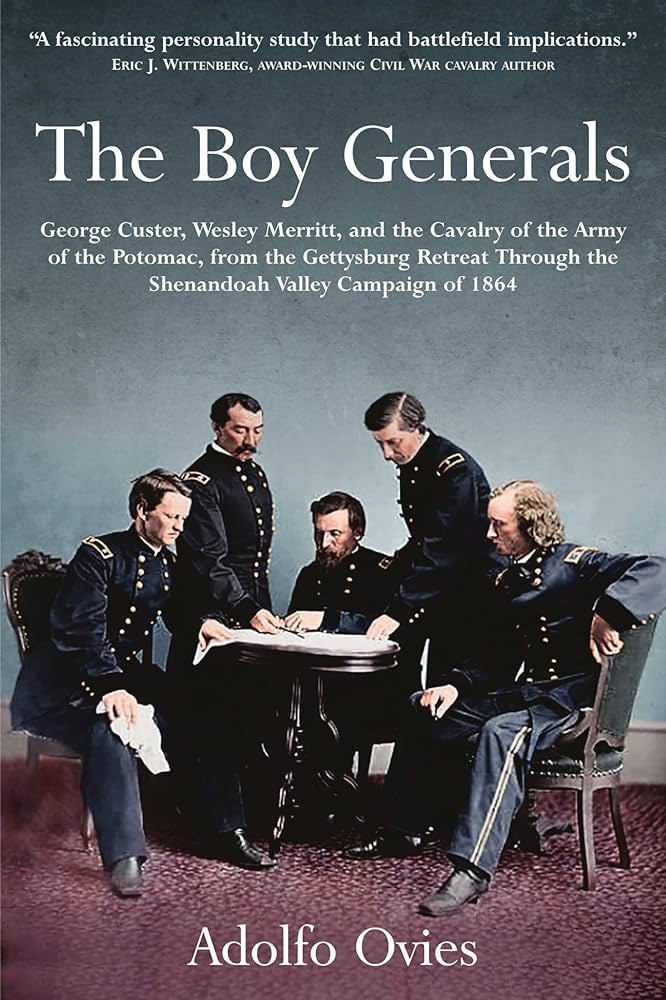
The Boy Generals: George Custer, Wesley Merritt, and the Cavalry of the Army of the Potomac, from the Gettysburg Retreat Through the Shenandoah Valley Campaign of 1864. By Adolfo Ovies. El Dorado Hills, CA: Savas Beatie, 2024. Hardcover, 352 pp. $34.95.
Reviewed by Robert M. Dunkerly
In The Boy Generals, author Adolfo Ovies explores the development of the Army of the Potomac's cavalry corps from the aftermath of Gettysburg through the 1864 campaigns. While historians generally acknowledge that the Federal cavalry achieved parity with their Confederate counterparts during the Gettysburg Campaign, Ovies dives into the details of their improvement.
A change in culture usually begins with leading individuals, and Ovies examines the important roles that George Armstrong Custer, Wesley Merritt, Alfred Pleasonton, Hugh Judson Kilpatrick, and other officers played in the cavalry's makeover. Ovies largely credits aggressive leadership combined with the widespread use of repeating carbines and new combat tactics in transforming the cavalry corps. In particular the author focuses on the rise of Custer and Merritt, examining their abilities and differences in personality and combat philosophies. Gen. Alfred Pleasonton often goes unnoticed as an officer in many Civil War studies, yet his aggressive leadership style led to the promotion of many like-minded officers, and his influence was significant, though he did not end his service with the Army of the Potomac.
Ovies offers readers a good overview of the post-Gettysburg operations in Pennsylvania and Maryland, as well as the late summer 1863 actions in central Virginia. The scouting, raids, and skirmishes of late July and August usually receive little coverage in Civil War histories, but here they get the attention they deserve. The vivid description of the fighting at Monterrey Pass in particular is an outstanding account of the chaos of combat and gives readers a better appreciation for what the men and horses endured.
The book next follows the cavalry's progression through the late summer and fall of 1863 in Virginia. In doing so it highlights lesser-known actions, including the Bristoe Campaign. Continuing into 1864, Ovies traces the cavalry corps through the hard-fought actions at Haw's Shop, Cold Harbor, and Trevilian Station.
In recounting various cavalry battles, Ovies provides sound analysis of the events, decisions, and actions made by the commanders. His careful sifting through official reports, letters, and other source material helps him evaluate the officers' performance. While the combat and mounted raids receive insightful and accurate coverage, at times too many details cloud the telling. Offering more context and taking a big picture approach would have helped clarify the narrative.
A strength of the book is the author's ability to provide readers with an inside look at how the Army of the Potomac's mounted arm operated during the period under study. Ovies highlights many of the issues that plagued the cavalry service including resupply, remounting, and logistics. Diseased and worn down horses were a distressing problem that needed constant attention. In many cases it is amazing that the cavalry could move effectively at all, let alone make the valuable contributions to the army that they did.
Also receiving significant attention are the internal tensions and frictions resulting from diverse personalities and clashing leadership styles in the cavalry corps. Adding to this potentially troubling mix were numerous command changes happening from the summer of 1863 through the spring of 1864, including Pleasanton's reassignment, the arrival of Philip Sheridan, and several others at the division and brigade levels. These behind the scenes views of the cavalry make important contributions to scholarship on the mounted branch.
Another important aspect of the book is its coverage of the evolution in cavalry weapons and tactics and the divergent methods of fighting, such as mounted versus dismounted, various skirmish formations, mounted charges, and the use of repeating weapons. Ovies includes the Confederate cavalry in his discussion, and the contrast is useful in better understanding the advancements that the Federal cavalry experienced.
Ovies spends a considerable amount of time analyzing Custer, his strengths and weaknesses, his contributions, and his evolution as a cavalry commander. The author notes the growing rift between Custer and Merritt, but he does not go into the same amount of detail with Merritt's career as he does Custer's. It seems that giving Merritt equal attention would only have helped balance this portion of the book.
The prologue moves rapidly into the details of the book and would have probably benefited from more contextual information, perhaps with the explanation that this book is part of a series. The book also ends rather abruptly with the late summer 1864 actions in the Shenandoah Valley. A conclusion or summary of key points would have been helpful, too. However, overall, The Boy Generals makes a valuable contribution to the study of cavalry in the eastern theater.


No comments:
Post a Comment