Read through planning documents across North America and you're bound to find language that refers to low-rise residential neighbourhoods as "physically stable areas" where the "existing neighbourhood character" is paramount. But to be more precise, what this kind of language is actually saying is not that these neighbourhoods need to be broadly stable; it is saying that they just need to look more or less stable.
Here in Toronto, for example, it has been widely documented that many of our low-rise neighbourhoods are losing people. Household sizes are getting smaller, and houses that used to be subdivided are being returned to single-family use. A similar thing is happening in other cities like New York:
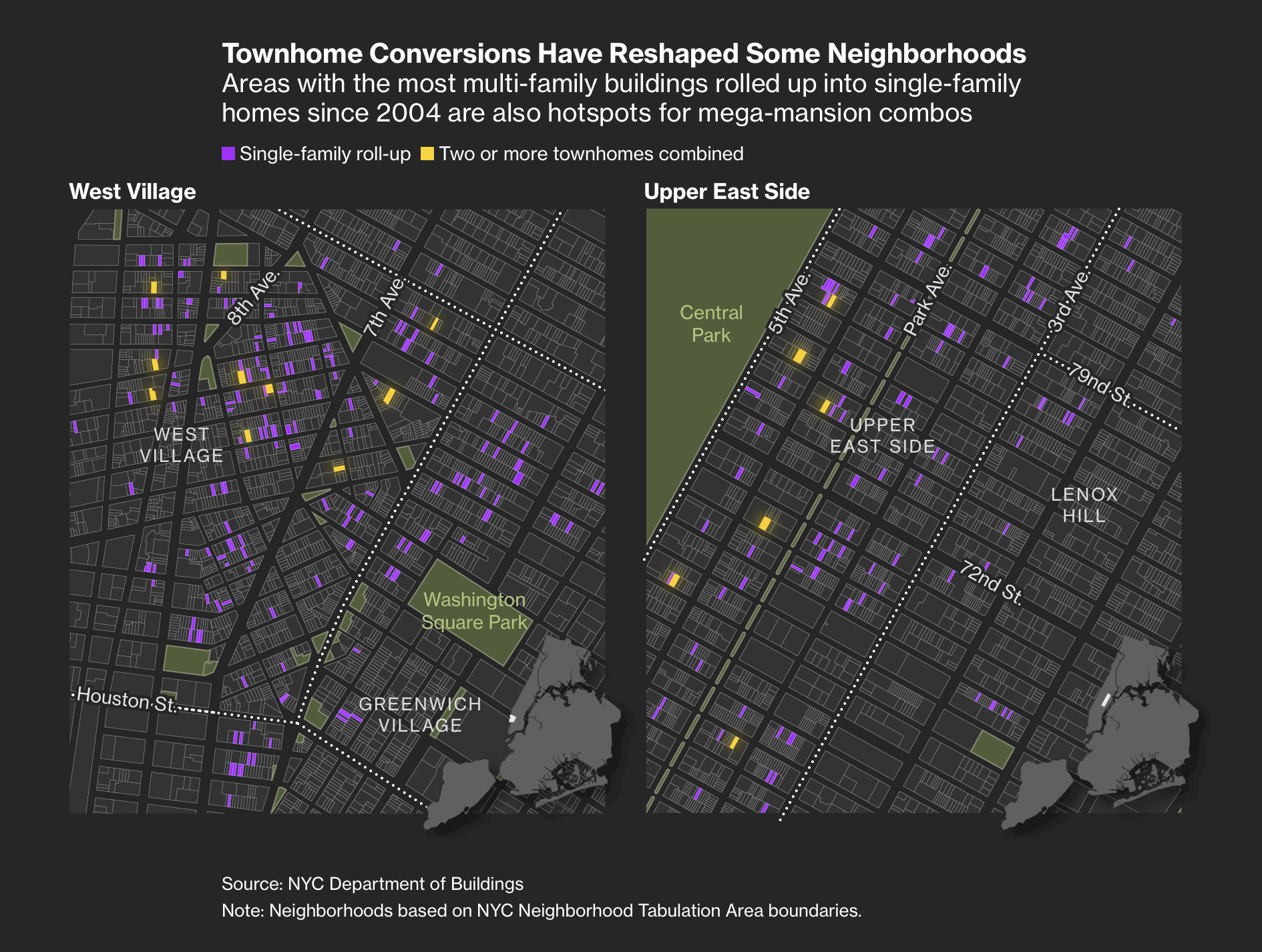
Bloomberg News recently reported that since 2004, at least 9,300 homes have been lost as a result of multi-family buildings getting "rolled up" into single-family homes. More recently, the city has even seen an increase in people combining two or more buildings into large urban mansions.
And while the total number of homes removed is relatively small for New York as a whole, it can be quite impactful to individual neighbourhoods. In the West Village, where there's a high concentration of rowhomes and townhouses, Bloomberg estimates that one out of every six small apartment buildings has been rolled up into a single-family home since 2004!
From a built form standpoint, you could say these are "physically stable" areas that are obediently adhering to their existing neighbourhood character. But under the hood and behind their street walls, they are clearly changing.
It is one of the great ironies of city building. People often fear new development because they worry it might disrupt the character of a neighbourhood. But preventing development does not guarantee stasis. In fact, we know that not building new housing actually increases the pressures felt on a city's existing housing stock, as people compete for a more fixed amount of supply.
The wealthy can always outbid the less wealthy on housing. So if you don't provide any new options, the wealthy will just buy up the existing stuff and turn it into what they want. Alternatively, you can build more housing and create a "moving chain" that frees up more existing housing for people of lower incomes.




No comments:
Post a Comment